

Cellular energy / mitochondrial context
Substrate, cofactors and oxygen delivery behind ATP production.
WHOLE-CASE CLINICAL REASONING · PHYSIOLOGY → CELL
Cell-First connects labs, history, symptoms, medications, supplements and trends into one transparent physiologic story — showing supporting and contradictory evidence, compensation, upstream and downstream relationships, clinical blind spots, cellular bottlenecks, priorities and reassessment.
The loudest finding is rarely the cause. Work upstream.
No credit card required · Fictional demonstration data · De-identified-first workflow · Built for clinicians

Labs, wearable data, supplements, medications, symptoms and patient history can all be present in the chart and still fail to answer the clinical question: how do these findings connect, what may be driving the case, what is compensatory, what does not fit, and what deserves attention first?
Cell-First does not stop at displaying results or drafting a plan. It organizes the reasoning between the data and the decision.
FROM SYSTEM TO CELL
Cell-First follows relevant physiology beyond organ-system labels into the biology that may be limiting function: cellular energy, mitochondrial substrate and cofactors, oxygen delivery, membrane and cellular signaling, inflammatory and oxidative tone, nutrient availability, recovery capacity, reserve and the cellular environment.
Substrate, cofactors and oxygen delivery behind ATP production.
Membrane physiology, glycation, fatty-acid balance and signaling context.
Nutrients evaluated by physiologic role and pattern, not deficiency labels alone.
Load, capacity, recovery and reserve held qualitatively — not as a simplistic score.
CLINICAL BLIND SPOTS
Cell-First identifies missing information that could strengthen, challenge or materially change the current interpretation.
ILLUSTRATIVE FICTIONAL EXAMPLE
INSIDE THE APPLICATION
The case overview answers what matters first. Priorities & Support begins with the ranked decisions, then lets clinicians open the clinical sequence, support options, bottlenecks, sleep and medication context, and action checklist as needed. Each view reads from the same case without hiding the underlying detail.

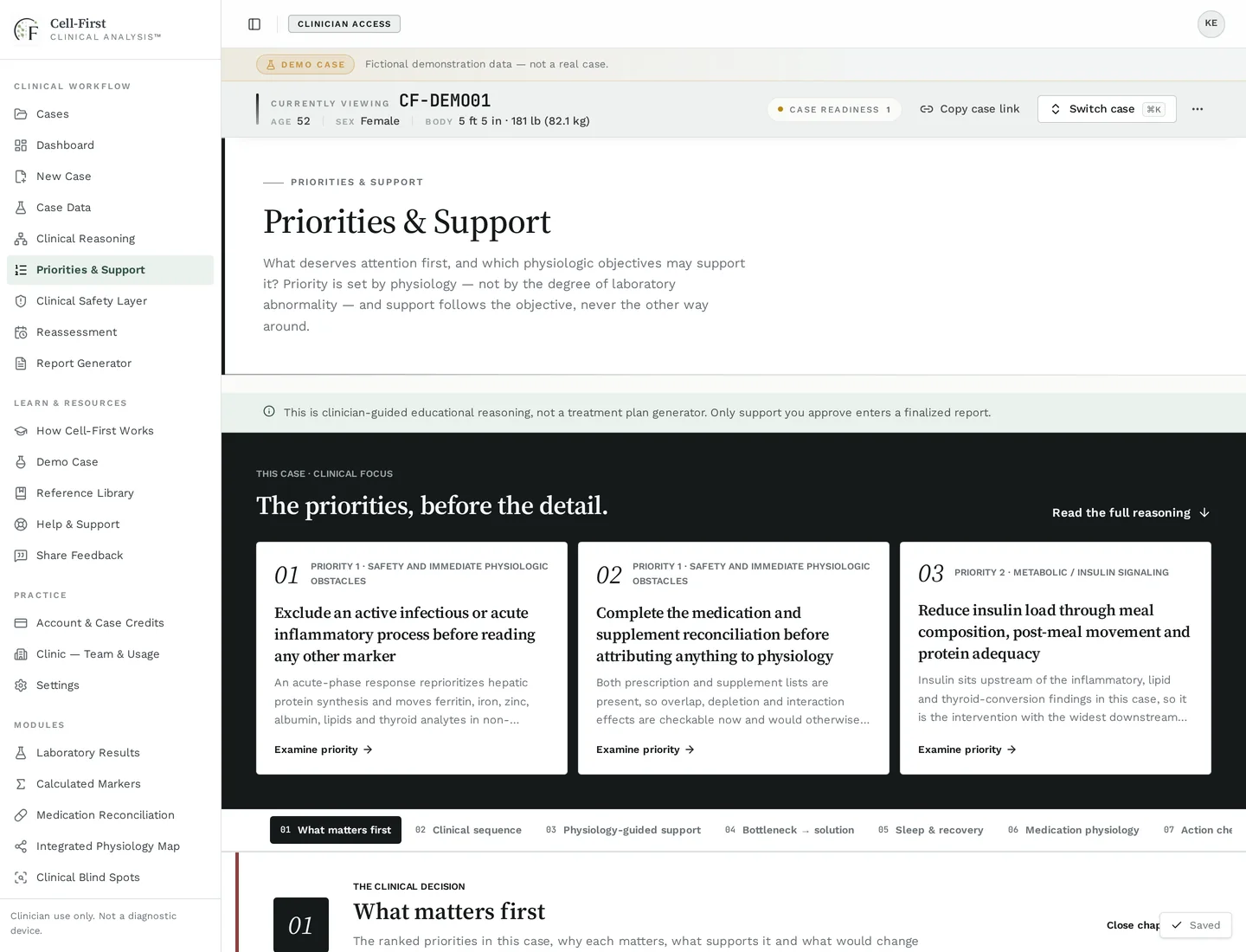
Priority follows where the physiology is limited, not the size of the flag.
Every statement points back to the labs, medications, sleep and trends in the case.
Every option — nutrient, lifestyle or modality — is judged on this case. When one is held back, the reason and what would change it are stated.
OPEN A CASE
A fictional case, the way Cell-First presents it. Expand the brief to see the laboratory findings that carry the pattern, the medications and supplements already in play, and a verified trend that disagrees with the number.
Fasting glucose has only just crossed the reference ceiling and lipids are treated, yet fasting insulin is high and inflammatory tone is elevated. Two supplemented nutrients — magnesium and iron — are still below functional target, which points at delivery rather than dose. The most visible abnormalities on this panel sit downstream of insulin signaling and nutrient uptake.
What matters first: identify which absorption step is failing before changing any dose.
HOW CELL-FIRST REASONS THROUGH A CASE
The complaint, the timeline, the thing the patient mentions on the way out the door — these decide which laboratory findings deserve weight. Cell-First keeps the story attached to the data instead of discarding it at intake.
THE PATIENT SAYS
“I fall asleep fine, but I’m awake at 3 a.m. and wired.”
ALSO IN THE CHART
Weight up 14 lb over two years, no change in diet.
THE PART USUALLY LOST
Afternoon energy crash, then a second wind at night.
None of this is a laboratory value. All of it changes how the laboratory values should be read.
Illustrative case language. Fictional data.
Reviewed one at a time, most of these values look unremarkable. Reviewed together, they describe a single mechanism under strain. Cell-First clusters findings before it interprets them.
Supported interpretation
Compensatory hyperinsulinemia with hepatic lipid handling strain
Five findings, one physiology. Read individually, four of them look mild.
Illustrative example only — not diagnostic.
Contradictory findings are shown next to supporting ones, never smoothed over. When the evidence is thin, the case says so rather than manufacturing confidence.
Supports the pattern
Argues against it
A normal HbA1c does not close the question. It may mean the compensation is still working — which is a different clinical situation than a case with no problem in it.
Terrain is how Cell-First holds that difference: what the system is carrying, what it can handle, how well it recovers, and how much margin remains. It is a reasoning frame, not a score.
LOAD
Elevated
What the system is being asked to carry.
CAPACITY
Adequate
The apparent ability to meet that demand.
RECOVERY
Reduced
Whether it restores itself between demands.
RESERVE
Insufficient data
How much margin appears to remain.
Terrain stays qualitative. Cell-First does not produce a terrain score, a 0–100 rating, or a “cellular age.”
Systems may compensate for each other until they cannot. Cell-First helps separate what may be driving the case from what the body may be doing about it, and from the findings that show up downstream on the panel.
UPSTREAM
Impaired insulin signaling
Where the physiology appears to begin.
COMPENSATION
Sustained hyperinsulinemia
The body holding the line.
DOWNSTREAM
Lipid handling, inflammation, vascular burden
The loud part.
Focusing only on the downstream finding can leave the larger physiologic pattern unexplained. Illustrative example only.
Findings are sequenced by safety, upstream position, supporting evidence, and likely systemic impact — so the visit has a defensible starting point rather than a list.
The hierarchy is dynamic — anemia, renal dysfunction, electrolyte disturbance, or medication toxicity can override the default sequence.
Reassessment compares verified timepoints inside the same immutable Case ID. What improved, what did not, and what that disagreement implies about the original interpretation.
| MARKER | PRIOR | CURRENT | INTERPRETATION |
|---|---|---|---|
| Fasting insulin | 18.0 | 9.4 | ▼ Improving |
| Triglyceride / HDL | 4.5 | 2.6 | ▼ Improving |
| hs-CRP | 3.4 | 3.1 | ▼ Improving |
| GGT | 48 | 31 | ▼ Improving |
Metabolic and hepatic markers improved. hs-CRP is also improving because it moved toward the desired range; however, the change is modest and the value remains elevated, so the persistent inflammatory load still needs explanation.
Illustrative example only — fictional demonstration data.
WHAT CELL-FIRST ANALYZES
Glucose regulation, insulin patterns, metabolic flexibility.
Inflammatory markers read in metabolic and tissue context.
Substrate, cofactor and oxygen delivery behind ATP production.
Membrane physiology, glycation, fatty-acid balance.
Nutrients evaluated by function, not deficiency labels.
Thyroid markers with nutrients, inflammation, medications.
Cortisol-driven effects on glucose, muscle, bone and sleep.
Liver and biliary patterns within metabolic context.
Methylation capacity and the transsulfuration exit to glutathione.
GI symptoms, immune data, nutrient status, inflammation.
Histamine load weighed against clearance capacity.
Lipoprotein burden, glucose physiology, vascular risk.
Red-cell indices, iron phenotype, and delivery to tissue.
Clearance, immune traffic, and interstitial load.
Filtration, hydration, electrolytes, and buffering reserve.
Urate read as renal handling and ATP turnover, not diet alone.
Sleep duration and timing carried through every affected system.
The restraint system linking stress, sleep, gut and pain findings.
Storage capacity and adipokine signaling behind metabolic strain.
Variants interpreted only against measured physiology.
Duplicates, interactions, cumulative dosing, nutrient effects.
BUILT FROM DECADES OF CLINICAL EXPERIENCE
Values were flagged, each one addressed on its own, and nobody stopped to ask what the body was doing as a whole. The patient was still unwell, and the chart said everything had been handled.
Physiology does not work in isolated lines. Findings connect. Systems compensate for each other until they cannot. What shows up as the most visible abnormality may be a downstream expression of something quieter upstream — and focusing only on the downstream finding can leave the larger physiologic pattern unexplained.
It does not replace your judgment. It gives your judgment the whole picture to work with.
Cell-First Clinical Analysis™ was developed by Kelly Brink, PhD, DFM, DNM, DHM, a registered nurse with more than 34 years of clinical healthcare experience and professional training spanning functional, natural, and holistic medicine and health and wellness coaching.
Kelly developed the Cell-First framework to help clinicians move beyond isolated findings and understand how the patient/client story, laboratory data, physiology, biochemistry, adaptation, compensation, cellular environment, recovery capacity, and reserve may fit together.
The goal is to understand the physiology first, identify what matters most, follow relevant physiology to the cellular level when supported by the case, make uncertainty visible, and use better reasoning to guide the next clinical questions.
Kelly Brink, PhD, DFM, DNM, DHM
Founder & Clinical Framework Developer
Registered Nurse — 34+ years clinical healthcare experience
Certified Health & Wellness Coach
About the founderREPORTS
A focused clinician-facing summary designed for rapid clinical review and documentation. Length adapts to case complexity while remaining concise and prioritized.
An in-depth clinician report for the full clinical record and deeper case understanding.
PATIENT / CLIENT REPORT
A clinician-reviewed, plain-language report designed to help the patient or client understand the major patterns, priorities, favorable findings, agreed support plan, and what will be reassessed.
It translates the clinical reasoning into clear educational language without presenting hypotheses as diagnoses or replacing appropriate medical care.
Finalized reports can be downloaded as PDF, printed, or exported as an editable Word document.
FREE DEMO
Explore a fully populated fictional case and follow the whole chain — the story, the connected findings, the contradictions, the terrain, the upstream driver, the blind spots, the prioritized support, and reassessment.
No credit card required • Fictional demonstration data
CLINICIAN ACCESS
Start with one case or choose a clinician plan based on your case volume and practice needs.
Cell-First brings clinical reasoning, physiology, prioritization, reassessment and reporting into one longitudinal clinician workflow.
$49
One-time
For clinicians who want to experience one complete live case before subscribing.
A low-risk way to experience the complete Cell-First workflow with a real case.
$99/month
$990/year — approximately 2 months free
For most clinicians using Cell-First regularly in practice.
$179/month
$1,790/year — approximately 2 months free
For higher-volume clinicians managing a larger ongoing caseload.
$349/month
$3,490/year — approximately 2 months free
For multi-clinician teams using Cell-First across a clinic.
Every case follows the same longitudinal reasoning workflow — from the patient story through physiology, prioritization and reporting.
Follow-up labs, reassessments and reports within the same Case ID do not consume another new-case credit.
A new case begins with a new Case ID. Follow-up information, reassessment and reporting for that same Case ID remain part of the existing longitudinal case and do not use another new-case credit.
Not ready for a live case? Explore the fictional demonstration case first.
WHY CELL-FIRST
| TRADITIONAL LAB-FLAGGING APPROACH | CELL-FIRST CLINICAL REASONING |
|---|---|
| Reference interval focus | Reference intervals + contextual clinician targets |
| A normal value ends the question | A normal value may reflect compensation |
| More tests | Information that could change the interpretation |
| One explanation | Competing interpretations, compared |
| One-time snapshot | Longitudinal reassessment |
| AI conclusion | AI-assisted analysis with clinician review |
A general conceptual comparison of approaches; no specific products or companies are described.
TRUST & SAFETY
Generated analyses remain editable and reviewable before finalization.
Interpretations display supporting evidence, contradictory findings, and confidence.
The system does not silently invent missing clinical information.
Clinically significant safety findings take precedence over optimization recommendations.
Clinical information is organized by Case ID, never patient names.
Every interpretation is labeled measured, calculated, supported, or hypothesis.
CLINICIAN USE ONLY
DE-IDENTIFIED-FIRST BY DESIGN
Cell-First is designed to work with non-identifying case information. The workflow uses Case IDs rather than patient names and does not require names, birth dates, medical record numbers, contact information or identifiable documents to reason through the current case structure.
Cell-First Clinical Analysis™ is an educational clinician reasoning and guidance platform. It does not diagnose disease, prescribe medication, provide medical treatment, or replace independent professional judgment or appropriate medical evaluation. Clinicians remain responsible for all clinical decisions and for operating within applicable professional scope and regulatory requirements.
FAQ
Explore a fictional case and see how Cell-First connects findings into a prioritized physiologic picture.
No credit card required • Fictional demonstration data • Clinician reasoning and educational guidance